
Mental Health Interpreting Services
Specialized ASL and spoken language interpreters for therapy, psychiatry, crisis, and recovery settings - with the continuity, register, and confidentiality that behavioral health demands.

What Makes Mental Health Interpreting Different?
Behavioral health is its own interpreting specialty. A therapy session isn't information transfer - it's pacing, register, silence, and rapport. The interpreter has to carry all of it faithfully: rendering in first person, preserving affect, holding pauses instead of filling them, and staying invisible enough that the clinical relationship forms between clinician and client.
That's also why informal solutions fail here. Family members, bilingual staff, or generalist interpreters change what clients disclose and how clinicians assess. A trained mental health interpreter protects the integrity of the session itself.
- Interpreters experienced in behavioral health settings
- First-person, register-faithful interpretation - including disorganized language
- Comfortable with therapeutic silence and pacing
- HIPAA-trained confidentiality practices on every assignment
- CDI teaming for clients with complex or atypical language
Settings We Cover
Across the behavioral health continuum, on-site and remote.
Outpatient therapy & counseling
Individual, couples, and family sessions - weekly continuity with the same interpreter wherever scheduling allows.
Psychiatric evaluations & medication management
Precise rendering of symptoms, side effects, and dosing instructions where accuracy directly shapes treatment.
Crisis & inpatient units
Rapid coverage for crisis stabilization and ED behavioral consults - on-demand VRI in seconds while on-site is dispatched.
Substance use & recovery programs
Group and individual treatment, intakes, and step programs interpreted with consistency across the program arc.
School-based counseling
Student counseling and behavioral supports coordinated with our education interpreting team.
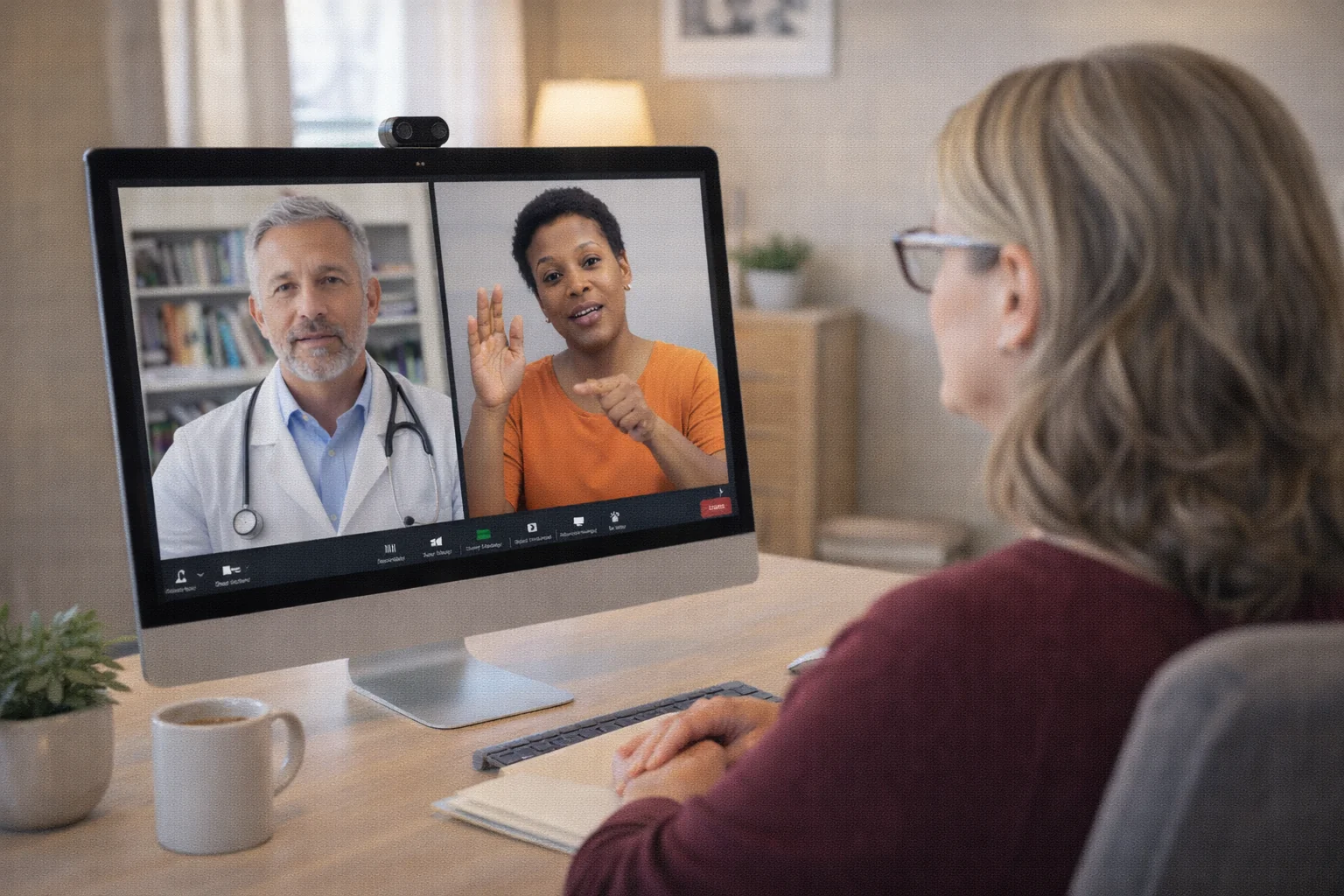
Behavioral telehealth
Teletherapy and telepsychiatry with the interpreter inside your video visit - see telehealth interpreting.
How We Support Your Clinical Team
Practices built for behavioral health, not adapted to it.
Continuity scheduling
Request the same interpreter for a recurring session series. Rapport and language familiarity compound across sessions instead of resetting.
Specialized experience
Interpreters who work in behavioral health regularly - familiar with therapeutic modalities, psychiatric terminology, and clinical boundaries.
Confidentiality by default
Professional codes of ethics plus our HIPAA-trained compliance module. Session content is never discussed outside the session.
CDI teaming
A Certified Deaf Interpreter pairs with a hearing interpreter when clients present atypical, emerging, or highly visual language.
Client preferences honored
Interpreter gender and continuity preferences accommodated wherever availability allows - small choices that change disclosure.
Every modality covered
On-site sessions, telehealth, and 26-second on-demand VRI for crises - one agency across the whole continuum of care.
Working with an Interpreter in Session
Four habits that make interpreted therapy work like direct therapy.
Brief the interpreter first
Two minutes before the session - modality, goals, any language notes from intake - lets the interpreter match your therapeutic approach.
Speak directly to your client
Use first person and eye contact with the client, not the interpreter. The interpreter renders everything, including tone.
Allow processing time
Interpretation adds a beat. Pauses and silence still do their clinical work - the interpreter will hold them, not fill them.
Keep the same interpreter
Request continuity for recurring sessions. Familiarity with the client's language and history compounds session over session.
Access matters here most: qualified interpreter access in behavioral health is both a legal requirement under the ADA and Section 1557 and a clinical one - assessment, diagnosis, and therapeutic alliance all depend on full communication. Our ADA regulations guide covers the obligations in detail.
Mental Health Interpreting FAQ
What clinical directors and practice managers ask us.
Can we request the same interpreter for every session?
Yes - and for therapy we recommend it. Continuity scheduling assigns the same interpreter to a recurring session series whenever availability allows, so rapport builds instead of resetting each week.
How is confidentiality handled?
Interpreters follow professional codes of ethics and complete our HIPAA-trained compliance module. What happens in a session stays in the session - the same standard your clinicians hold.
What is a Certified Deaf Interpreter, and when is one needed?
A CDI is a Deaf professional who teams with a hearing ASL interpreter for clients with atypical, emerging, or highly visual language - common in trauma, developmental, and psychiatric contexts. When intake suggests complex language needs, we recommend and staff a CDI team.
Can you cover crisis or same-day needs?
Yes. For unscheduled needs - crisis stabilization, ED behavioral consults, urgent intakes - our on-demand VRI platform connects an interpreter in a 26-second average while an on-site interpreter is dispatched if needed.
Do you support telehealth therapy sessions?
Yes. The interpreter joins your video platform as a participant for teletherapy and psychiatry visits - see our telehealth interpreting service for how the workflow runs.
Do you provide spoken language interpreters for behavioral health?
Yes. Spanish and 60+ other languages, with interpreters experienced in therapy and psychiatric settings, on-site or remote.
Set Up Interpreter Coverage for Your Program
Tell us about your settings, languages, and session cadence - we'll build continuity coverage with crisis backup.