
The Language Access Compliance Guide
What Title VI, the ADA, and Section 1557 actually require, how to run the four-factor analysis, and how to build a language access plan that works on the ground - written for the person who just got handed the job.

What "Language Access" Actually Means
Language access is one program with two populations. For people who are limited English proficient (LEP), it means meaningful access to your services in their language - interpreters for conversations, translations for documents. For people who are Deaf or hard of hearing, it means effective communication through qualified sign language interpreters, captioning, and other auxiliary aids.
Organizations that treat these as separate problems build two half-programs. The obligations come from different statutes, but the operational answer is one plan: know your population, contract qualified services in every modality, train your staff, tell the public, and keep records.
Done well, language access isn't a compliance tax - it's how public-facing programs reach the people they exist to serve.
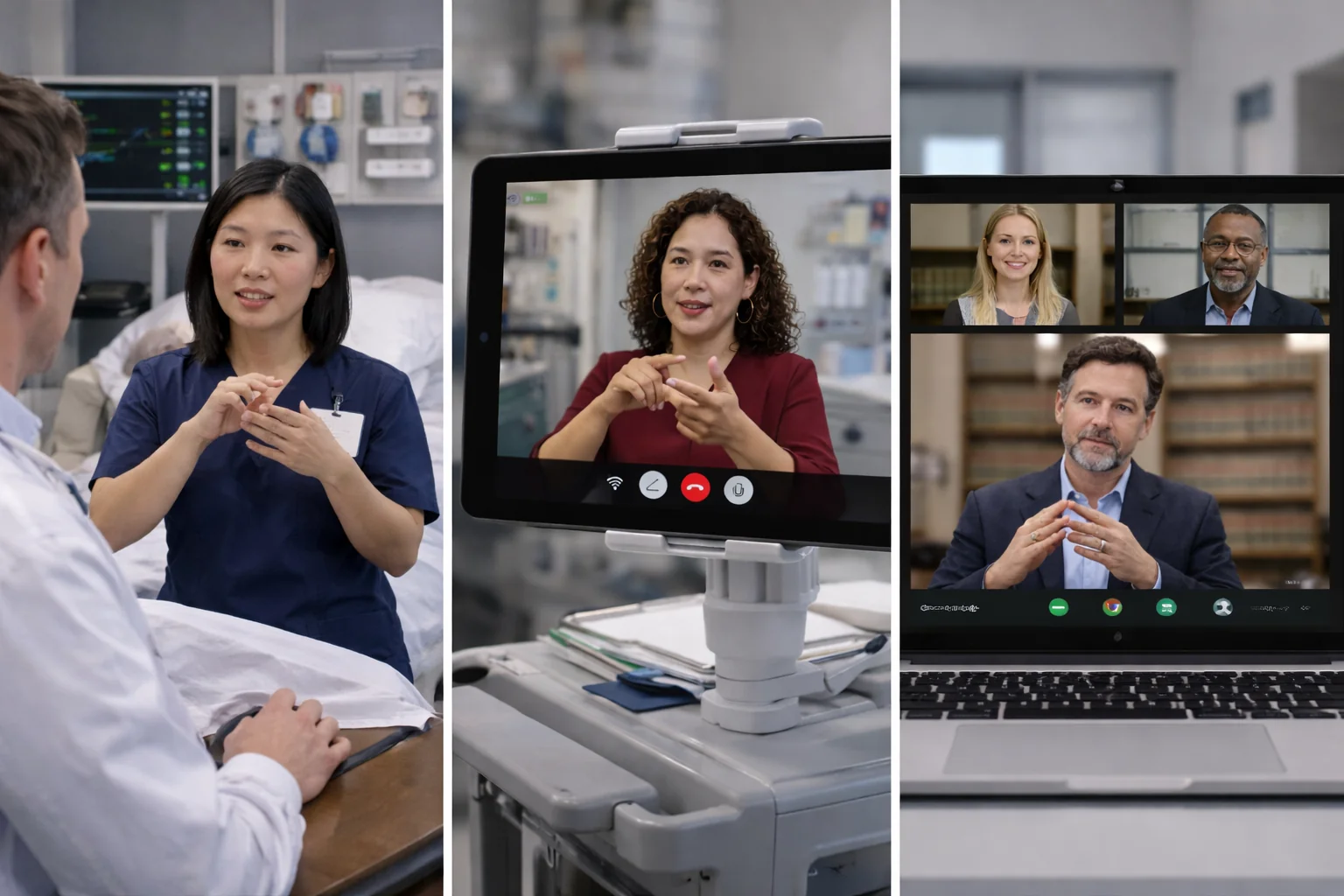
The Legal Framework
Four layers, one obligation: communicate so people can actually use your services.
Title VI - Civil Rights Act
Recipients of federal financial assistance must take reasonable steps to provide LEP individuals meaningful access to programs - the principle the Supreme Court affirmed in Lau v. Nichols. Executive-branch guidance has shifted over the years, but the statute and case law are the foundation; follow your funding agency's current requirements.
ADA - Titles II & III
State and local governments and public accommodations must ensure effective communication with people who are Deaf or hard of hearing, providing auxiliary aids like qualified interpreters and CART. Public entities must give primary consideration to the aid the individual requests. Our ADA regulations guide goes deeper.
Section 1557 - ACA
Covered health programs must provide qualified interpreters for LEP and Deaf patients, may not rely on family members or minors except in emergencies, must review machine translation with a qualified human translator where accuracy matters, and must post notices of available language assistance.
State & local law
States add their own layer - court interpreter standards, agency language-access mandates, and in Maryland, the Sign Language Interpreters Act, which establishes licensure for ASL interpreters on a timeline our tracker keeps current.
The Four-Factor Analysis
The standard framework for scaling your LEP obligations to your reality.
Who you serve
The number or proportion of LEP individuals in your service population - measured from data, not assumption.
How often
Frequency of contact with LEP individuals. Daily front-desk encounters demand more than an annual event.
What's at stake
The nature and importance of the program. Healthcare, benefits, legal rights, and safety information sit at the top.
What you have
Your resources and the cost of options. Remote services have lowered this bar - capability now scales to any budget.
Weigh the four together and document the reasoning. High numbers, frequent contact, and high stakes point to robust in-language services; the analysis - written down - is also your evidence of a good-faith process.
Building Your Language Access Plan
Five components every workable plan shares.
Assess your population
Identify the languages - spoken and signed - your service area actually uses. Census and school-district data, intake records, and frontline staff logs reveal both current demand and gaps.
Inventory services and line up vendors
Map what each encounter type needs: on-site interpreters, VRI, OPI, translated documents, CART. Contract qualified providers before the need is urgent.
Set policy and train staff
Write down how staff request an interpreter, what's prohibited (relying on minors, family, or ad-hoc bilingual staff), and how to work with interpreters. Train everyone with public contact.
Post notice of availability
People can't use services they don't know exist. Add multilingual 'free interpreter services available' notices at points of contact, on vital documents, and on your website.
Monitor, document, and update
Track requests, fulfillment times, and complaints. Review the plan on a schedule and after demographic shifts - documentation is your best evidence of good faith.
Applications, consent forms, notices of rights or denial, complaint procedures, emergency instructions - anything a person needs to access your services or protect their rights. These get professional translation (certified where documents carry legal weight, as in immigration filings) rather than machine output.
Choosing the Right Service for Each Encounter
A working plan matches modality to moment - most organizations use several.
| Situation | Best fit | Why |
|---|---|---|
| Scheduled appointments, complex or lengthy matters | ✓ On-site interpreting | Full visual context and presence for high-stakes, nuanced communication |
| Unscheduled walk-ins, urgent Deaf/HoH encounters | ✓ VRI | Qualified ASL interpreter on screen in a 26-second average |
| Planned video meetings and remote sessions | ✓ Virtual interpreting | A dedicated interpreter joins your Zoom, Teams, or Meet session |
| Telemedicine visits | ✓ Telehealth interpreting | HIPAA-trained interpreters inside the video visit itself |
| Quick spoken-language phone contacts | ✓ OPI | 60+ languages on any phone in under a minute |
| Written materials and vital documents | ✓ Document translation | Human translation, certified when it needs to hold up |
| Public meetings, events, and broad audiences | ✓ Event teams + CART | Interpreter teams plus live captions reach the whole room and the stream |
Where Language Access Programs Fail
Six patterns that show up in complaints and audits.
Relying on family members or minors
Comfortable in the moment, prohibited in healthcare outside emergencies, and corrosive everywhere: accuracy, privacy, and disclosure all suffer when the interpreter is a relative - or a child.
Treating bilingual staff as interpreters
Speaking two languages is not interpreting. Untrained staff summarize, editorialize, and omit - use them for direct service in-language, not as interpreters, unless they're assessed and trained for the role.
Machine-translating vital documents
Raw machine output on consent forms and notices creates errors with legal consequences. Where accuracy matters, a qualified human translates or reviews.
Forgetting the Deaf half of the plan
Plans that stop at spoken languages miss the ADA entirely. Effective communication for Deaf and hard-of-hearing individuals - interpreters, CART, VRI - belongs in the same program.
Providing services nobody knows about
Without posted, multilingual notice of free interpreter services, eligible people never ask - and unused capacity looks like absent capacity in an audit.
Keeping no records
No request log, no fulfillment data, no documented analysis. When a complaint arrives, the paper trail is the difference between a good-faith program and an allegation.
Language Access FAQ
The questions compliance leads ask most.
Does Title VI apply to our organization?
If your organization receives federal financial assistance - directly or passed through a state or local agency - Title VI applies, and that includes taking reasonable steps to give limited English proficient individuals meaningful access to your programs. Hospitals, schools, transit systems, housing programs, and county services are all commonly covered. When in doubt, check your funding agreements.
We're a small organization. Do the same rules apply?
The obligation scales rather than disappears. The four-factor analysis explicitly weighs your resources and the nature of your services - a small nonprofit and a hospital system won't build identical programs. But small size doesn't excuse having no plan, and remote services like OPI and VRI have made baseline coverage affordable at any scale.
Can we charge clients for interpreter services?
No. Under the ADA and Section 1557, the cost of auxiliary aids and interpreter services can't be passed to the individual who needs them. Budget for language access as a program cost, the same as any other accessibility measure.
Does language access apply to telehealth and virtual services?
Yes. Effective communication obligations follow the service, not the building. Video visits, virtual public meetings, and online programs need interpreter access just as in-person ones do - see our telehealth interpreting page for how that works in practice.
Which documents do we need to translate?
Prioritize vital documents: anything essential to accessing your services or exercising rights - applications, consent forms, notices of rights or denial, complaint procedures, and emergency information. Translate those into the languages your service population actually uses, and provide certified translation where documents carry legal weight.
What's the status of interpreter licensure in Maryland?
Maryland enacted a Sign Language Interpreters Act establishing licensure for ASL interpreters, with implementation timelines that have shifted - our Maryland Sign Language Interpreters Act timeline tracks the current dates and what they mean for organizations that hire interpreters.
Put the Plan into Operation
One certified, Deaf-owned vendor for every modality in this guide - interpreting, translation, and captioning, with the documentation your compliance file needs.